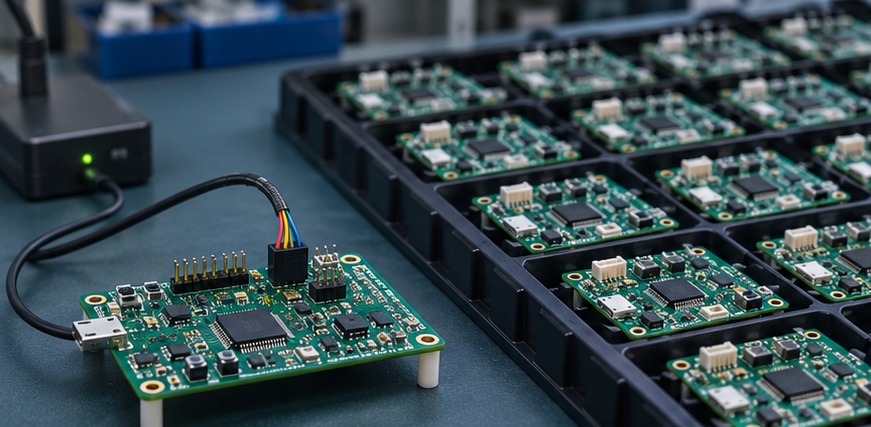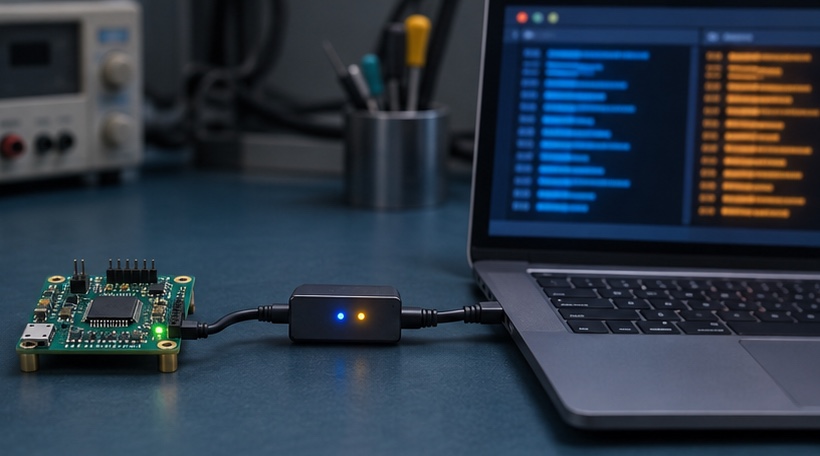
What is a FlashRunner?
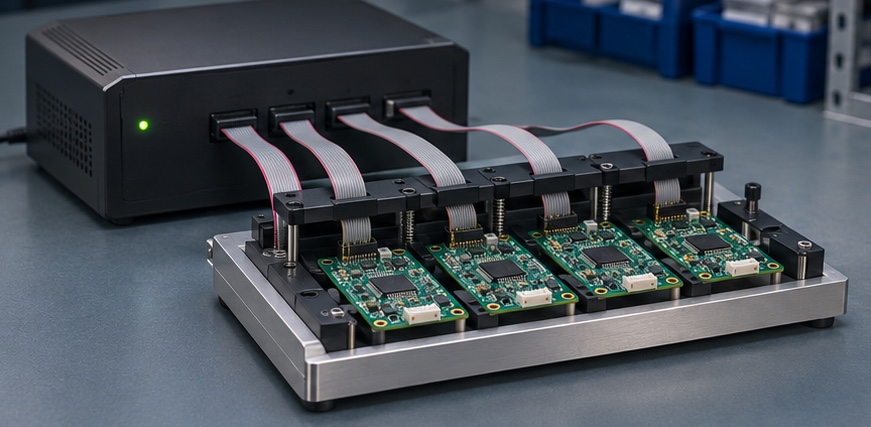
FlashRunner is a family of industrial programmers from SMH Technologies. It loads firmware or other production data into a microcontroller or memory chip after the chip has been soldered onto the printed circuit board assembly (PCBA). That is called in-system programming, or ISP. A FlashRunner with multiple independent channels can program several targets in parallel. When you run the same job across a batch of boards, this is often called gang programming.
How does it work?
1. Connect the board. A fixture can use spring-loaded contacts, called pogo pins, to touch programming pads on the board. Some setups use a cable and connector instead. 2. Run a programming project. Think of it as the recipe for the job. It tells FlashRunner which file to load, how to talk to the chip and which operations to perform. You can start the job from an operator station or integrate it into an automated test station. 3. Check the result. A typical project erases the relevant memory as needed, writes the data and verifies it. The station uses the result to decide which boards pass and which need attention.
Six questions to ask before ordering
1. Which exact devices are you programming? Send the manufacturer, full part number and package or module variant for each target. Include the intended programming interface per device, for example UART, SPI/QSPI, SWD or JTAG. Ask the supplier to confirm support for the exact device and interface on the model you are buying. 2. What needs to run in parallel? Say how many boards are in a fixture or panel, how many targets are on each board and whether the station programs one device type per batch or different types at the same time. Share your required cycle time. Measure the full cycle, including fixture handling and verification, when deciding how many channels to buy. 3. How does the programmer connect to the board? Share the programming pinout, target voltage and power arrangement. Identify the cables, adapters and fixtures you want to reuse. If the station switches power or signals through external relays, say what is switched and whether the station or the programmer controls it. Share the relevant wiring diagram if you want the supplier to validate the integration. 4. How will the station start and track each job? Specify whether the setup is standalone, operator-driven or controlled by a host application or automated tester. For an upgrade, include the current programmer model and explain which scripts and projects need to carry over. State whether you need an enclosed unit or an open-frame version, and ask which options are available for the configuration you want. 5. What exactly is included in the quote? Ask for the hardware model, enabled channel count, covered devices, any production licenses or algorithm packages, and the required accessories. An algorithm is the device-specific method FlashRunner uses to program a chip. Ask whether existing licenses can be reused on a new model or serial number, and have the supplier list any new items you need. 6. What should you prove on real boards? Run a trial on representative assemblies with the intended fixture and firmware. Check programming and verification results for every channel, measure the full cycle, and confirm how the station handles a failed channel before rolling the setup into production.
Moving from four to twelve boards per batch
A station that programs one target per board on four boards at a time may want to run twelve identical boards per batch. State that the new batch uses one device type at a time and describe any other device jobs separately. For a standard kit quote, start with the target list, desired channel count and licenses. Bring in the fixture pinout, cabling and relay details when you need to confirm what can be reused or who will own the integration. Twelve enabled channels let you run more targets in parallel when the fixture and project support it. The gain in boards per hour depends on the full station cycle.
Requesting a quote? Send ISS Group your target device list, board and panel layout, channel count and cycle-time goal. Tell us whether you want a standard kit or help sizing and validating the complete station. Request a quote from ISS Group.
Manufacturer references
PUT KNOWLEDGE INTO PRACTICE
Let’s talk about your application.
Buy online in The LAB eShop, or ask ISS for advice and a tailored quotation.
Shop online ↗Request a quote →